Introduction
Walking your dog should be enjoyable, but that can feel impossible when every approaching dog triggers barking, pulling, whining, or lunging. If you are wondering how to stop a dog from barking at other dogs on leash, the answer is usually not a louder “no” or a tighter leash. The real solution is understanding what causes the reaction and teaching your dog a different response.
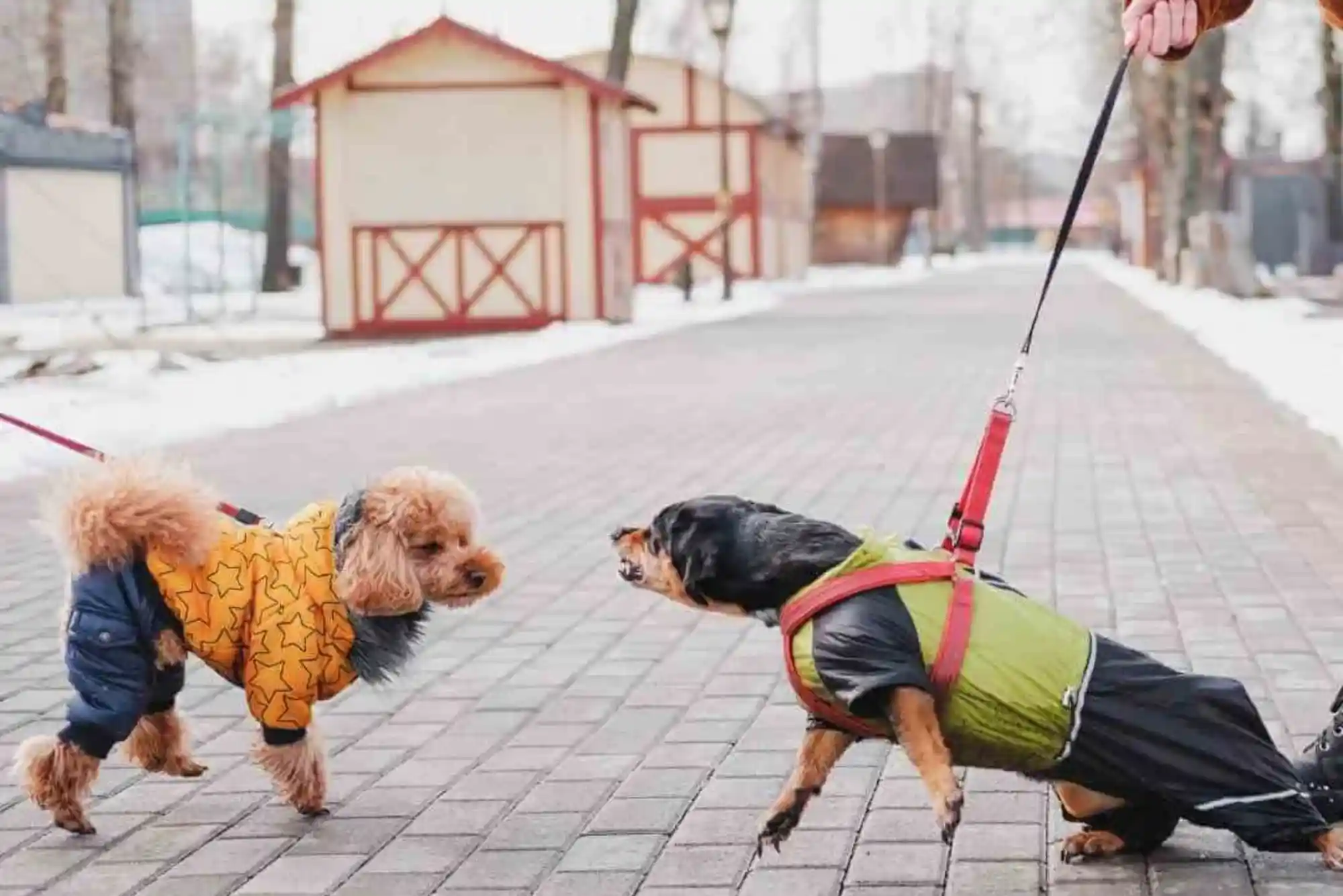
Leash reactivity is common. A reactive dog may bark because it feels frightened, frustrated, overexcited, or unable to control the distance between itself and another dog. Best Friends Animal Society notes that barking, growling, pulling, and lunging can all be expressions of leash reactivity, particularly when a dog is trying to increase distance from something it finds uncomfortable.
The good news is that leash reactivity can often be improved with careful management and consistent behavior modification. The goal is not necessarily to make your dog love every dog it sees. Instead, you want your dog to notice another dog, remain under control, and eventually disengage without exploding into a barking episode.
Why Does a Dog Bark at Other Dogs on Leash?
Before deciding how to stop a dog from barking at other dogs on leash, identify what is driving the behavior. Barking is communication, and the same outward behavior can have different causes.
Fear and Anxiety
Some dogs bark because another dog makes them uncomfortable. They may stiffen, lower their body, tuck their tail, avoid eye contact, or try to move away before barking.
For these dogs, barking may be a distance-increasing behavior. In simple terms, the dog has learned that barking can make the other dog move farther away. If the approaching dog eventually disappears, the barking may become even more strongly reinforced.

Frustration and Excitement
Not every barking dog is frightened. Some dogs desperately want to greet another dog but become frustrated because the leash prevents them from approaching.
These dogs may lean forward, wag their tails, pull toward the other dog, whine, jump, and bark. Their emotional state can still become overwhelming, even if their original motivation is friendly.
Lack of Experience or Poor Social Learning
A dog that has had limited exposure to different dogs may not know how to behave during close encounters. Adolescence, previous negative experiences, and inconsistent socialization can also contribute to reactivity.
Importantly, barking does not automatically mean a dog is aggressive. Context, body language, history, and the dog’s ability to recover after the trigger passes all matter.
What Is Leash Reactivity?
Leash reactivity describes an exaggerated response to a trigger while a dog is restrained. The trigger may be another dog, a person, bicycle, vehicle, or something else.
When another dog appears, a reactive dog might stare intensely, freeze, bark, growl, pull, or lunge. Some dogs react from fear, while others are driven by frustration or excitement.
The important concept is your dog’s threshold. This is the distance at which your dog can notice another dog without losing the ability to think, eat treats, respond to you, or move calmly.
If your dog can see another dog from 60 feet away but starts barking at 30 feet, 60 feet may be a useful starting point for training.
Trying to train at 20 feet simply because you want faster progress can backfire. Once your dog is already barking and lunging, learning becomes much harder.
How to Stop a Dog from Barking at Other Dogs on Leash
The most effective approach combines management, desensitization, and counter-conditioning. Rather than forcing your dog to tolerate another dog at close range, you control the environment so your dog can practice staying calm.
Start With Distance
Distance is one of your most useful training tools.
When you see another dog approaching, do not wait until your dog begins barking. Cross the street, turn down another path, step behind a parked vehicle, or simply move farther away.
You are not rewarding the barking by moving away. You are preventing your dog from rehearsing the unwanted behavior while creating a situation where learning is possible.
Once your dog can notice the other dog while remaining relatively relaxed, you have a workable training distance.
Teach Your Dog That Seeing Another Dog Predicts Something Good
This is where counter-conditioning becomes valuable.
The moment your dog notices another dog, calmly mark the moment with a word such as “yes” and immediately provide a high-value reward. Chicken, cheese, or another food your dog finds especially motivating can work well.
The timing matters. Ideally, your dog sees the other dog and then receives the reward before the reaction begins.
Over repeated sessions, the emotional association can change. Instead of thinking, “Another dog is coming; I need to bark,” your dog begins to learn, “Another dog appeared, and good things happen when I stay calm.”
The ASPCA similarly recommends using special treats before a dog begins barking when dogs appear during walks.
Reward Looking Away
A particularly useful skill is teaching your dog to disengage from the trigger.
Your dog may initially stare at another dog. Instead of immediately demanding eye contact, give your dog a moment to notice the trigger. When your dog looks back toward you, mark and reward that decision.
This creates an important pattern: notice the dog, then return attention to the handler.
Over time, the behavior can become almost automatic.
Keep Training Sessions Short
Reactive-dog training can be mentally exhausting. A long walk filled with repeated close encounters may actually give your dog dozens of opportunities to practice barking.
Instead, aim for controlled practice. A few successful encounters can be more useful than a long session in which your dog repeatedly goes over threshold.
End the training while your dog is still succeeding. This helps keep the experience productive rather than overwhelming.
What to Do When Your Dog Suddenly Starts Barking
Even with careful planning, unexpected dogs will appear.
If your dog suddenly begins barking, do not panic or start shouting. Avoid repeatedly saying “quiet” while your dog is already highly aroused.
Instead, create distance as calmly as possible.
Turn around and walk away. Use a parked car, hedge, driveway, or other visual barrier if available. Once your dog can focus again, offer a reward and allow the nervous system to settle.
Your priority during an unexpected reaction is management, not perfection.
A common mistake is staying in place because the owner believes the dog must “face its fear.” Forcing a dog to remain close to a trigger while it is already overwhelmed can increase stress rather than teach calm behavior.
Practice an Emergency U-Turn
An emergency U-turn can make walks much easier.
Practice it at home first. Say a cheerful cue such as “this way,” turn around, and encourage your dog to follow you. Reward your dog for coming with you.
Repeat the exercise during ordinary walks when there are no triggers around.
Eventually, the cue becomes useful when another dog suddenly appears. Instead of pulling desperately on the leash, you have a rehearsed behavior that tells your dog, “We are going this way.”
This is not avoiding training. It is good management that prevents unnecessary reactions while your long-term training continues.
Avoid Punishment-Based Solutions
When a dog is barking loudly, it can be tempting to correct the behavior with yelling, leash jerks, intimidation, or punishment-based equipment.
However, if the barking is caused by fear or anxiety, punishment can make the underlying emotional response worse. The ASPCA specifically cautions against punishment procedures for barking associated with fear or anxiety unless advised by an appropriately qualified behavior professional.
Punishment can also suppress visible warning signals without addressing the underlying emotion. A dog that stops growling because it has learned that growling is punished has not necessarily become more comfortable around other dogs.
Training should focus on changing the dog’s response and giving it an appropriate alternative.
How to Tell Whether Your Dog Is Improving
Progress is not always measured by complete silence.
A dog may still bark occasionally while showing meaningful improvement. Perhaps your dog notices another dog but recovers within seconds instead of remaining fixated for a minute. Maybe your dog can respond to its name from a greater distance. Perhaps the barking has changed from frantic lunging to one brief vocalization followed by looking at you.
These are useful signs.
Track the distance at which your dog can remain calm, how quickly your dog recovers, and whether your dog can eat and respond to familiar cues around other dogs.
Over time, you want to see the threshold gradually shrink. A dog that once needed 100 feet of distance may eventually handle the same trigger at 70, then 50, then 30 feet.
Do not rush this process.
Create a Better Walking Environment
Training becomes easier when the rest of your dog’s routine supports emotional stability.
Choose quieter walking routes while you work on reactivity. Avoid crowded dog parks or narrow paths where escape options are limited. Give your dog opportunities to sniff and explore without constantly confronting triggers.
A properly fitted harness can also provide better physical control during walks, although equipment alone will not solve reactivity.
Most importantly, learn to scan the environment ahead of you. Spotting another dog before your dog does gives you valuable time to make a decision.
When Should You Get Professional Help?
Professional help is appropriate when your dog’s reactions are intense, unpredictable, worsening, or difficult to manage safely.
Consider working with a qualified positive-reinforcement trainer or veterinary behavior professional if your dog regularly lunges, redirects aggression toward the leash or handler, cannot recover after encounters, or is difficult to control physically.
Adopt-a-Pet’s behavior guidance also recommends seeking help from a positive-reinforcement professional when barking around other dogs or strangers becomes particularly difficult to manage.
A veterinary assessment can also be worthwhile if the behavior appears suddenly, changes dramatically, or occurs alongside signs of pain or other physical problems.
How Long Does It Take to Stop Leash Reactivity?
There is no universal timeline.
A young dog with mild frustration may improve relatively quickly, while a fearful dog with years of rehearsal may require considerably more time. Your dog’s history, genetics, environment, trigger distance, training consistency, and emotional response all influence progress.
Be careful with anyone promising a guaranteed cure in a specific number of days.
Behavior modification is rarely perfectly linear. You may have several excellent walks followed by a difficult day. That does not necessarily mean the training has failed.
Think in terms of trends rather than individual walks.
If reactions are becoming less intense, recovery is getting faster, and your dog can work closer to triggers while remaining responsive, you are moving in the right direction.
Common Mistakes That Slow Progress
One of the biggest mistakes is repeatedly allowing the dog to reach the point of barking and lunging. Every intense reaction gives the behavior another opportunity to become practiced.
Another mistake is reducing distance too quickly. Owners naturally want to see progress, but moving from 50 feet to 20 feet after one good session can put the dog straight back over threshold.
Some owners also rely too heavily on commands. A cue such as “sit” or “look at me” can be useful, but it cannot replace emotional behavior modification.
Finally, do not compare your dog with another dog. Two dogs can react to the same trigger for completely different reasons.
The goal is not to produce a dog that ignores every animal in existence. The goal is to help your individual dog feel safe enough to make better choices.
Build Calm Walks One Step at a Time
Learning how to stop a dog from barking at other dogs on leash requires patience, observation, and consistency. Start by identifying why your dog reacts, then work at a distance where your dog can still think and respond.
Use high-value rewards to create positive associations, reinforce disengagement, practice an emergency U-turn, and avoid unnecessary confrontations. Most importantly, prevent your dog from repeatedly rehearsing explosive reactions.
Leash reactivity is not something you need to solve in a single walk. Small improvements add up. With structured practice and the right approach, walks can gradually become calmer and more predictable for both you and your dog.
FAQs
Why does my dog bark at other dogs on walks?
Dogs may bark at other dogs because of fear, frustration, excitement, anxiety, or previous experiences. A leash can make the reaction stronger because it restricts the dog’s ability to approach or move away. Barking by itself does not prove that a dog intends to fight.
How do I get my dog to stop barking at other dogs?
Start by creating enough distance that your dog can see another dog without immediately reacting. Reward calm observation and disengagement with high-value treats. Gradually reduce the distance as your dog’s ability to remain calm improves.
Why does my dog bark and lunge at other dogs but never bites them?
Barking and lunging can be caused by fear, frustration, or overexcitement. Some dogs are trying to make another dog move away, while others are frustrated because they cannot reach the dog. Behavior should be assessed in context rather than assuming that barking automatically means aggression.
How can I teach my dog the quiet command?
Teach the cue in a low-distraction environment first. Reward brief moments of silence and gradually introduce mild distractions. When a dog is already highly aroused by another dog, creating distance and helping the dog settle is generally more useful than repeatedly demanding “quiet.”
Should I let my reactive dog greet other dogs on leash?
Not necessarily. If your dog becomes highly aroused during on-leash greetings, allowing repeated greetings can reinforce pulling, barking, and frustration. Focus first on calm observation and disengagement. Controlled interactions with suitable dogs can be considered separately when appropriate.
When should I seek professional help for my dog’s barking?
Professional assistance is particularly useful when your dog regularly lunges, cannot take treats around other dogs, is difficult to physically control, or the behavior is getting worse. A qualified positive-reinforcement trainer or veterinary behavior professional can help identify the cause and develop an individualized plan.